

Slime Molds and Cognitive Maps

November 24st, 2026

Oğul Can Yurdakul

Department of Cognitive Science, UC Irvine

Slime Molds and Cognitive Maps

November 24st, 2026

Oğul Can Yurdakul

Department of Cognitive Science, UC Irvine


Home > World of the Slime Mold > Computational Models > Results and Outcomes > Future directions

World of the Slime Mold

The slime itself: Physarum polycephalum

  • eukaryote but not a fungus!
    • amoeboid protist
  • "syncytium:" one cell, millions of nuclei!

center

  • plasmodium: mobile form
    • few mm to over half a m
    • can move up to 1cm/h
  • has inspired many work, including an optimization algorithm

center
(a) Fragments of sclerotium. (b) Sporangia. (c) Spores. (d) Swarm cell (arrowed). c, d Scale bar = 10μm

Home > World of the Slime Mold > Computational Models > Results and Outcomes > Future directions

Mapping the world with/of the slime mold

Slime molds as path finders

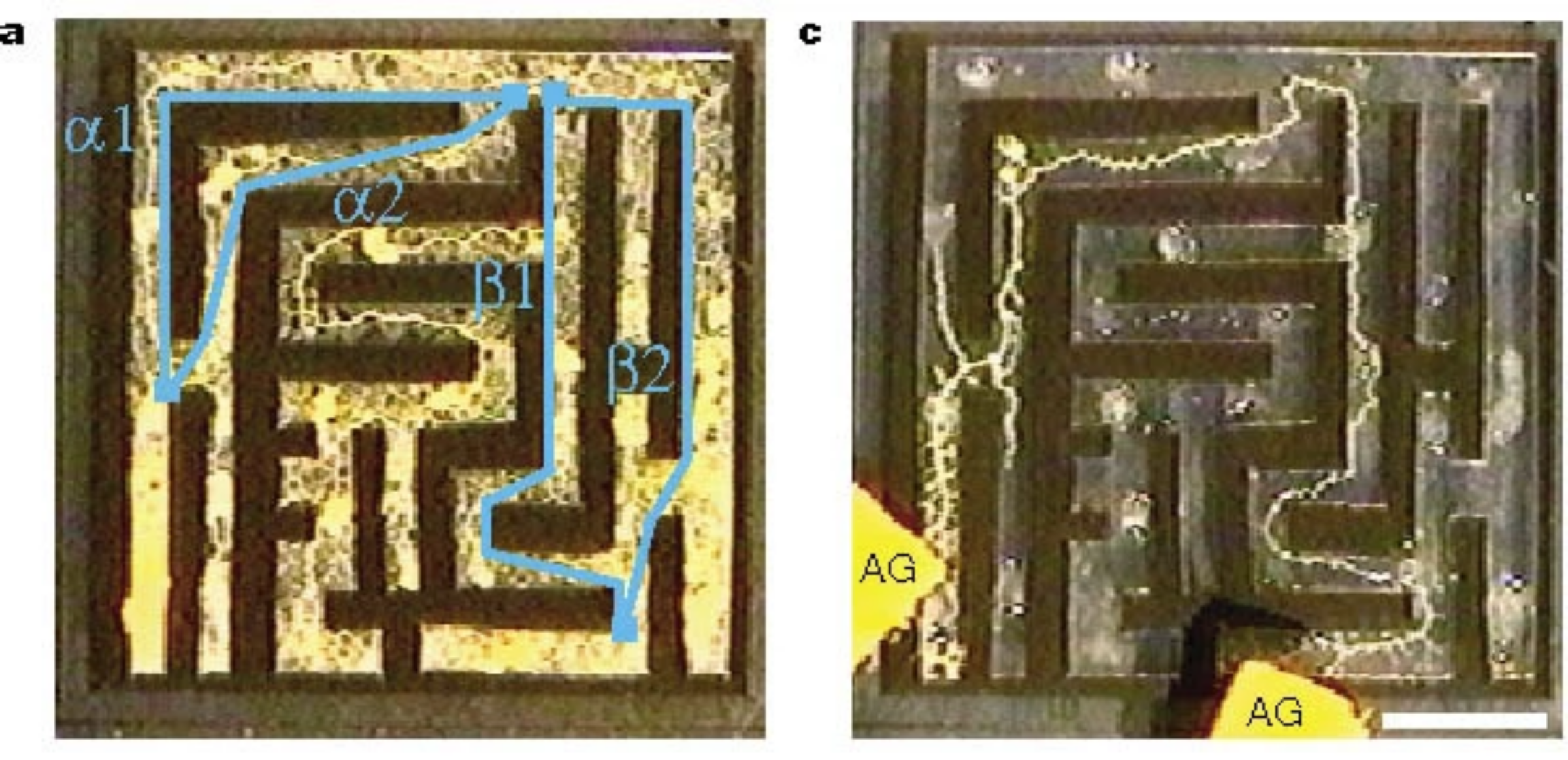
  • Maze solving

Home > World of the Slime Mold > Computational Models > Results and Outcomes > Future directions

Mapping the world with/of the slime mold

Slime molds as path finders

  • Maze solving

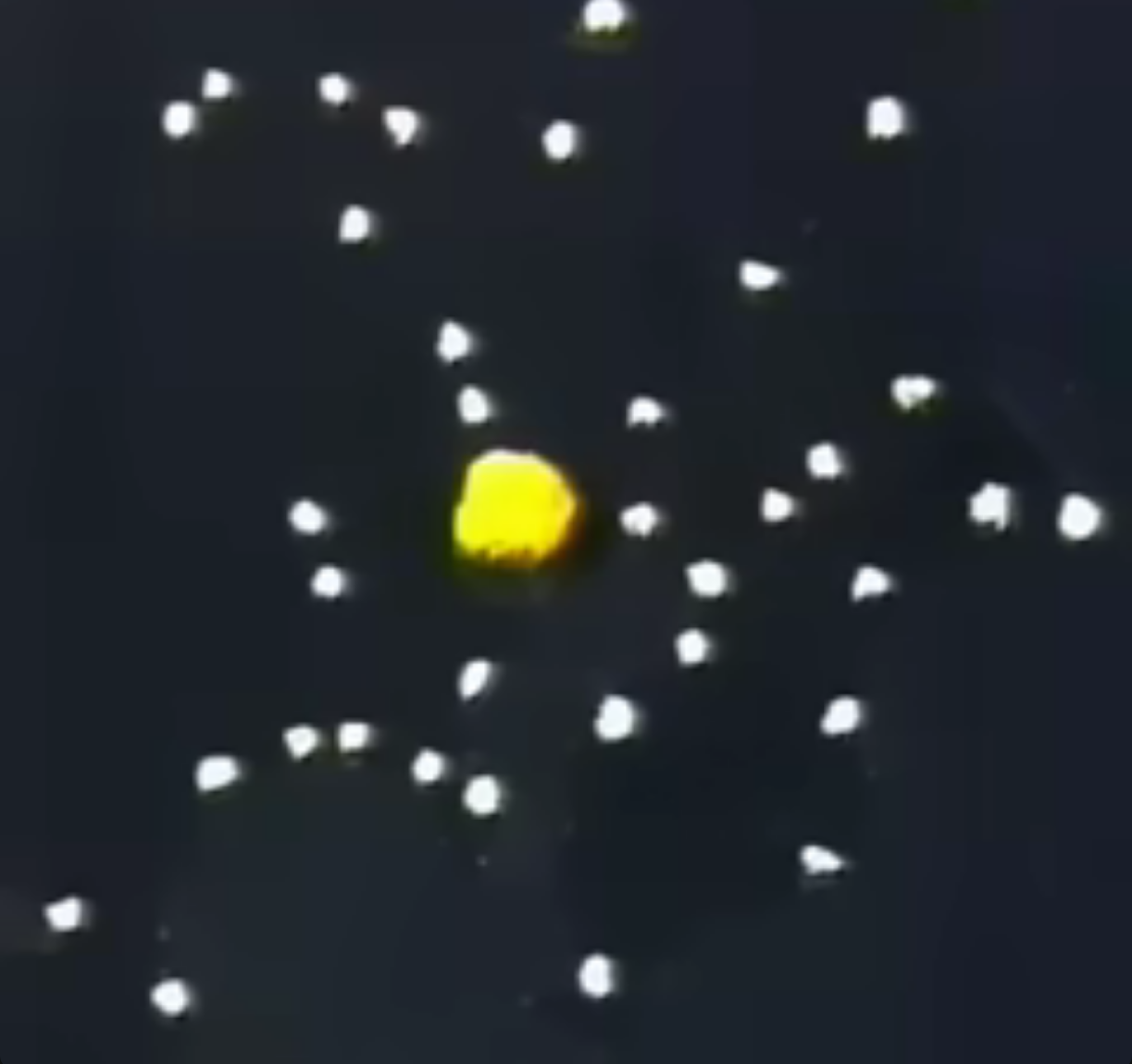
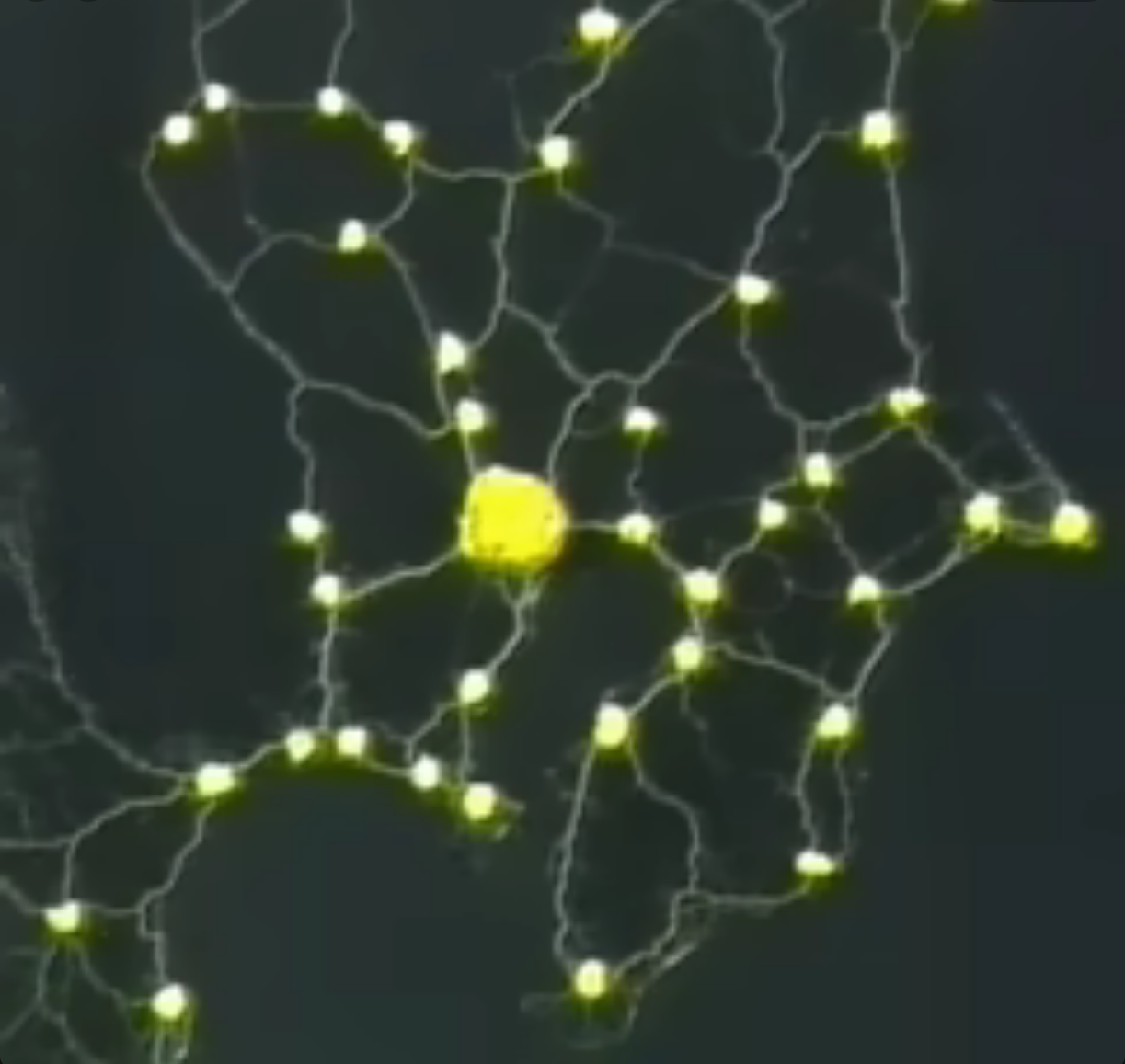
  • Tokyo subway map

Home > World of the Slime Mold > Computational Models > Results and Outcomes > Future directions

Mapping the world with/of the slime mold - 2

Slime molds as "problem solvers"

  • Traveling salesperson problem
    center

Bajpai et al. (2026) “Tracking and distinguishing slime mold solutions to traveling salesperson problems through synchronized amplification in the non-equilibrium steady state,” http://arxiv.org/abs/2504.03492
Reid and Beekman (2013) “Solving the Towers of Hanoi – how an amoeboid organism efficiently constructs transport networks,” https://doi.org/10.1242/jeb.081158
Home > World of the Slime Mold > Computational Models > Results and Outcomes > Future directions

Mapping the world with/of the slime mold - 2

Slime molds as "problem solvers"

  • Traveling salesperson problem
    center
  • Towers of Hanoi puzzle
    center
    center

Bajpai et al. (2026) “Tracking and distinguishing slime mold solutions to traveling salesperson problems through synchronized amplification in the non-equilibrium steady state,” http://arxiv.org/abs/2504.03492
Reid and Beekman (2013) “Solving the Towers of Hanoi – how an amoeboid organism efficiently constructs transport networks,” https://doi.org/10.1242/jeb.081158
Home > World of the Slime Mold > Computational Models > Results and Outcomes > Future directions

Mapping the world with/of the slime mold - 3

Slime molds as ???

  • Urban designers?
Home > World of the Slime Mold > Computational Models > Results and Outcomes > Future directions

Mapping the world with/of the slime mold - 3

Slime molds as ???

  • Urban designers?
  • Romans??
Home > World of the Slime Mold > Computational Models > Results and Outcomes > Future directions

Mapping the world with/of the slime mold - 3

Slime molds as ???

  • Urban designers?
  • Romans??

  • Colonizers???

Home > World of the Slime Mold > Computational Models > Results and Outcomes > Future directions

To err is human slime mold

Speed-accuracy trade-off

when having to choose between food sources, adding stressors reduce accuracy of choosing the larger one

Home > World of the Slime Mold > Computational Models > Results and Outcomes > Future directions

To err is human slime mold

Speed-accuracy trade-off

when having to choose between food sources, adding stressors reduce accuracy of choosing the larger one

dark: easy
gray: difficult

Home > World of the Slime Mold > Computational Models > Results and Outcomes > Future directions

To err is human slime mold

Speed-accuracy trade-off

when having to choose between food sources, adding stressors reduce accuracy of choosing the larger one

dark: easy
gray: difficult

Independence of Irrelevant Alternatives

when an overall worse option is introduced into a choice among two, slime molds sometimes choose it

dark: two-choice setup
gray: three-choice setup

Home > World of the Slime Mold > Computational Models > Results and Outcomes > Future directions

Computational Models

Analytically derived

  • the slime mold's thickness is assumed to be/approximated by a mathematical rule

center

Home > World of the Slime Mold > Computational Models > Results and Outcomes > Future directions

Computational Models

Analytically derived

  • the slime mold's thickness is assumed to be/approximated by a mathematical rule

center


real slime mold patterns


simulation results

Home > World of the Slime Mold > Computational Models > Results and Outcomes > Future directions

Computational Models

Analytically derived

  • the slime mold's thickness is assumed to be/approximated by a mathematical rule

center


real slime mold patterns


simulation results

Monte Carlo-based

  • lots of small particles make small decisions to generate overall behavior

center

center

Home > World of the Slime Mold > Computational Models > Results and Outcomes > Future directions

Analyticaly derived models

Tero et al (2007) adapted Kobayashi et al. (2006)'s model to graphs

  • flux from node to :

    where is the conductivity of the edge, are pressures at nodes

  • two nodes are special: one is source, one is sink

    flux conserved at regular node

    flux generated at source node

    flux consumed at sink node

  • adapt the conductivities according to

center

  • this is just a lumped circuit model!
    • is node voltages,
    • is the current,
    • is the conductance

center

Home > World of the Slime Mold > Computational Models > Results and Outcomes > Future directions

Monte Carlo-based models

simple actions of little particles can give rise to complex behavior at the population level...

Jones (2010)'s model:

center
center

Home > World of the Slime Mold > Computational Models > Results and Outcomes > Future directions

Monte Carlo-based models

simple actions of little particles can give rise to complex behavior at the population level...

Jones (2010)'s model:

center
center

can we build on this?

  • say each particle "looks" at all the nodes it can travel to and assigns a positive "score" to each of them
    • softmax decision:
      • sample the next node proportional to these scores
    • Metropolis-Hastings decision:
      • sample a candidate next node
        • if better, move there
        • if worse, move or stay probabilistically
Home > World of the Slime Mold > Computational Models > Results and Outcomes > Future directions

Shortcomings of the current models

Tero et al. (2007):

center

  • biologically undesirable model
    • the function is not as interpretable
    • food sources are modeled asymmetrically
  • no repulsion term: light or slime
  • no "exploration"

Jones (2010):

center

  • no accounting of the path-finding effects
  • no food, no light, just slime
Home > World of the Slime Mold > Computational Models > Results and Outcomes > Future directions

Results and Outcomes

  • a ratinabox-style toolbox emerges!
    • world = slimeWorld(node_locs, C_, light, slime, opts)
    • slime = circuitSlime(world, options)
    • slime = softmaxSlime(world, options)
    • slime = MHslime(world, options)
  • example:

center

center

center


Home > World of the Slime Mold > Computational Models > Results and Outcomes > Future directions

Results and Outcomes

Path-finding and detours

center


Home > World of the Slime Mold > Computational Models > Results and Outcomes > Future directions

Results and Outcomes

Path-finding and detours

center

center


Home > World of the Slime Mold > Computational Models > Results and Outcomes > Future directions

Results and Outcomes

Path memory

center


Home > World of the Slime Mold > Computational Models > Results and Outcomes > Future directions

Results and Outcomes

Path memory

center

center


Home > World of the Slime Mold > Computational Models > Results and Outcomes > Future directions

Results and Outcomes

Undesirable paths

center

center


Home > World of the Slime Mold > Computational Models > Results and Outcomes > Future directions

Future directions

  • Tolman's sun maze: Latent learning in slime molds?

center


Home > World of the Slime Mold > Computational Models > Results and Outcomes > Future directions

Future directions

  • Tolman's sun maze: Latent learning in slime molds?

center

center


Home > World of the Slime Mold > Computational Models > Results and Outcomes > Future directions

Future directions

  • Tolman's sun maze: Latent learning in slime molds?

center

center

  • Spatial memory
  • Temporal memory: accommodation to repeated stimuli
  • Foraging experiments
  • Memory sharing in slime molds in contact
  • ...

Home > World of the Slime Mold > Computational Models > Results and Outcomes > Future directions

Thank you!


![h:200 center](mazeSolving.png)

![h:200 center](mazeSolving.png)

![h:200](tokyoBefore.png) ![h:200](tokyoAfter.png)

![h:140](colonization2.png)

- $s(\mathbf x, t)$ is the sol thickness - $p(\mathbf x, t)$ is sol pressure

- $s(\mathbf x, t)$ is the sol thickness - $p(\mathbf x, t)$ is sol pressure
- $s(\mathbf x, t)$ is the sol thickness - $p(\mathbf x, t)$ is sol pressure

- $s(\mathbf x, t)$ is the sol thickness - $p(\mathbf x, t)$ is sol pressure

![width:300 center](wardog.gif)